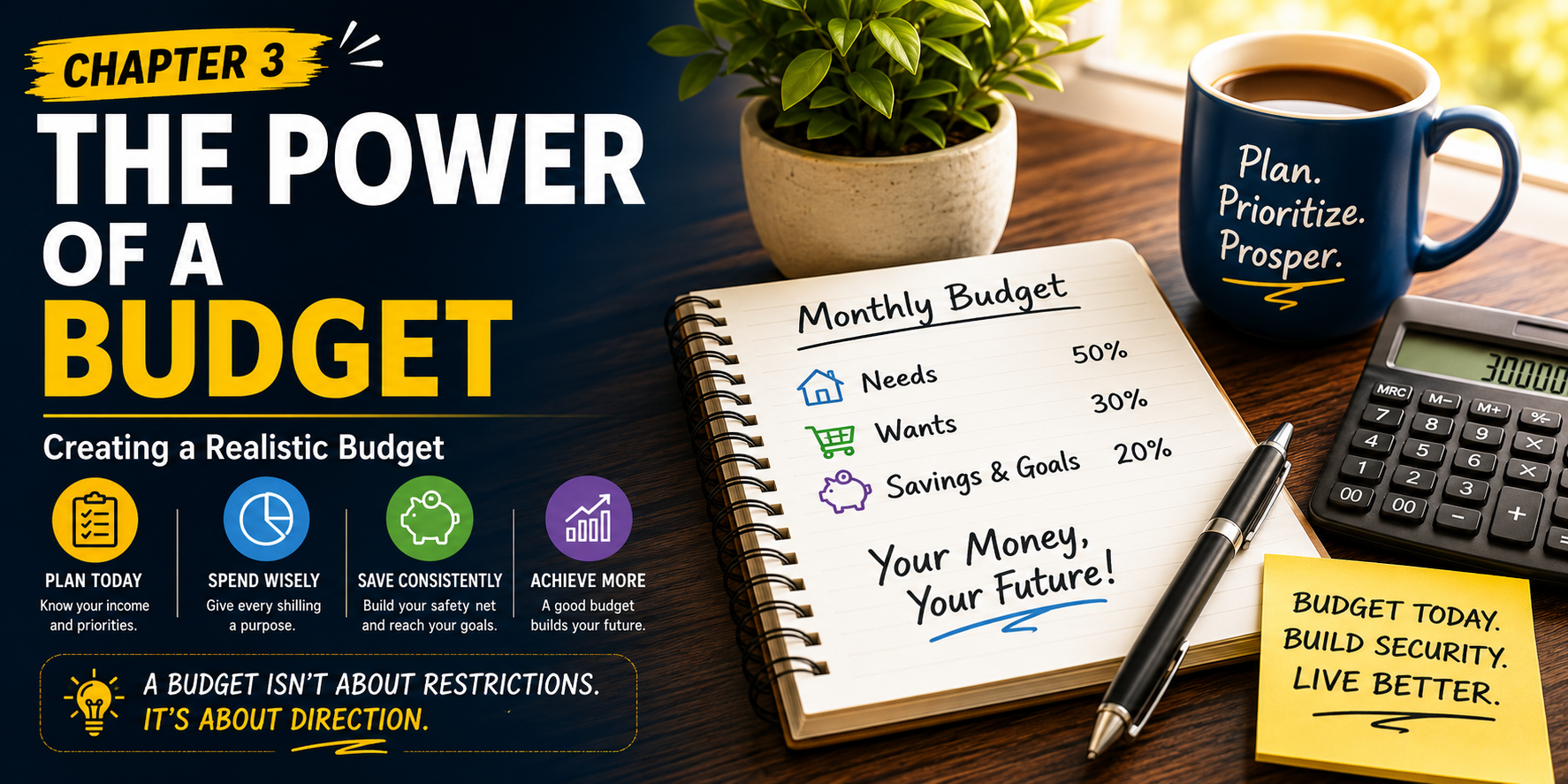
A budget is where financial awareness turns into financial action.
After learning the importance of understanding your money and knowing where it goes, the next step is to create a plan that gives your money direction. A budget helps you decide what should happen with your money before you spend it.
Many people think budgeting means restricting yourself or avoiding everything you enjoy. That is not what a good budget should do. A realistic budget should help you meet your responsibilities, work toward your goals, and still enjoy your money without losing control.
What Makes a Budget Powerful?
A budget gives you a framework for making financial decisions.
Without one, you may make spending decisions based on what feels affordable at the moment. With a budget, you make those decisions based on your bigger financial priorities.
For example, you might want to buy a new phone. Instead of simply asking whether you have enough money in your account, a budget encourages you to consider whether buying it fits into your current financial priorities.
This creates a difference between having money and having a plan for your money.
You can have KSh 20,000 in your account and still not be able to comfortably spend KSh 10,000 if part of that money is already committed to rent, school fees, savings, or another important goal.
Start With Your Priorities
A realistic budget begins with your priorities.
Not everyone has the same financial responsibilities or goals. Your budget should therefore be designed around your own circumstances rather than someone else's lifestyle.
Think about what matters most to you.
Perhaps you want to build savings, start a business, pay off debt, support your family, invest, continue your education, or purchase something important.
Once you identify these priorities, your budget becomes easier to organize.
For example, if building an emergency fund is one of your biggest goals, your budget should give that goal a specific amount rather than leaving savings to whatever happens to remain at the end of the month.
Try the 50/30/20 Rule
One popular budgeting framework is the 50/30/20 rule.
It divides your available money approximately as follows:
- 50% for needs
- 30% for wants
- 20% for savings and financial goals
For example, if you have KSh 40,000 available, the guideline would allocate around KSh 20,000 to needs, KSh 12,000 to wants, and KSh 8,000 to savings or other financial goals.
However, this is only a starting point.
Your circumstances may require a different approach. If your essential costs are high, you may need more than 50% for needs. If you are aggressively saving for a major goal, you may decide to reduce the amount allocated to wants.
A budgeting rule should guide you, not control you.
Give Every Amount a Purpose
One effective budgeting method is to assign your available money to specific purposes.
Imagine you have KSh 30,000 available for the month.
Instead of leaving the entire amount in one account and spending from it whenever something comes up, you can divide it according to your priorities.
For example:
- KSh 10,000 — housing and essential needs
- KSh 5,000 — food and transportation
- KSh 3,000 — savings
- KSh 3,000 — bills
- KSh 2,000 — personal spending
- KSh 2,000 — financial goals
- KSh 5,000 — flexible or planned expenses
The exact amounts are not important. What matters is that you decide where the money should go before spending it.
This is sometimes called zero-based budgeting, where every shilling is assigned a purpose.
Money allocated to savings has a purpose. Money allocated to bills has a purpose. Money allocated to enjoyment also has a purpose.
Plan for Irregular Expenses
Some expenses do not happen every month, but that does not mean they should be ignored.
Examples include school fees, annual subscriptions, insurance payments, clothing, travel, repairs, birthdays, and other occasional responsibilities.
If you know an expense is coming, prepare for it early.
Suppose you expect to need KSh 24,000 for an annual expense. Instead of looking for KSh 24,000 when the payment is due, you could set aside KSh 2,000 each month.
After twelve months, you will have the amount ready.
This strategy turns large expenses into smaller, manageable contributions.
Set Spending Limits
A budget becomes more useful when you establish clear limits.
Instead of saying:
“I will try not to spend too much on entertainment.”
Say:
“I will spend a maximum of KSh 2,000 on entertainment this month.”
The second statement gives you a measurable target.
You can create limits for shopping, eating out, entertainment, subscriptions, transportation, and other flexible expenses.
These limits do not mean you can never spend more. They simply force you to make a conscious decision before exceeding your planned amount.
Leave Yourself Some Freedom
An unrealistic budget is one that leaves no room for enjoyment.
If you decide that you will never eat out, never buy anything unnecessary, and never spend money on entertainment, you may eventually become frustrated and abandon the entire budget.
Instead, create a reasonable amount for personal enjoyment.
Financial discipline does not mean you cannot enjoy your money.
It means you enjoy your money without allowing short-term pleasure to destroy long-term goals.
Having a planned spending allowance can actually make it easier to remain disciplined because you know you have money available for things you enjoy.
Build a Financial Buffer
Unexpected things happen.
A phone may break. A family responsibility may appear. Transportation costs may increase. You may need to make an urgent purchase.
If every shilling in your budget is already committed, even a small unexpected expense can cause problems.
For this reason, consider leaving some money uncommitted or creating a small financial buffer.
This gives your budget flexibility.
The goal is not to predict every possible problem. It is to make sure that one unexpected expense does not completely destroy your financial plan.
Review and Improve Your Budget
Your first budget will probably not be perfect.
You may underestimate certain costs. You may discover that a particular category needs more money than expected. Your income may change, or your financial priorities may shift.
That is normal.
A budget should be reviewed and adjusted regularly.
Ask yourself:
What worked this month?
Where did I struggle?
What can I change next month?
Instead of seeing mistakes as failure, use them as information.
The purpose of budgeting is not to create a perfect financial plan on the first attempt. It is to continuously improve your relationship with money.
Budgeting Creates Financial Confidence
One of the biggest benefits of budgeting is confidence.
When you know that your important obligations are planned for, your savings have a purpose, and your spending has boundaries, you can make financial decisions with greater confidence.
You are less likely to wonder where your money disappeared.
You are also less likely to make major financial decisions based purely on emotions.
A budget gives you a clear picture of what you can afford and what needs to wait.
The Bigger Lesson
A budget is more than numbers written on paper.
It is a decision-making system that helps you turn your income into progress.
The goal is not to spend as little as possible. The goal is to spend intentionally.
A successful budget should help you take care of today's responsibilities while preparing for tomorrow's opportunities.
You do not need an expensive application or complicated spreadsheet to begin. A notebook, phone, spreadsheet, or simple budgeting tool can be enough.
Start with a realistic plan. Give your money specific purposes. Set reasonable limits. Leave room for unexpected situations. Review your results and make adjustments.
Most importantly, remember:
A budget does not take away your financial freedom. It helps you build it.
Key Takeaways
- A budget gives your money direction.
- Your budget should reflect your personal priorities.
- Use budgeting rules as guides rather than strict laws.
- Give every major portion of your money a purpose.
- Prepare for irregular expenses before they arrive.
- Set realistic spending limits.
- Leave room for enjoyment and unexpected costs.
- Review and adjust your budget regularly.
- Focus on consistency rather than perfection.
Tomorrow's Chapter: Chapter 4 — Saving Before Spending: Building the Saving Habit.
#FinancialManagement #PersonalFinance #Budgeting #MoneyManagement #FinancialLiteracy #BudgetTips #SmartMoney #FinancialGoals #MoneyHabits #FinancialPlanning #MoneyMindset #PersonalBudget #BudgetingTips #FinancialFreedom #BuildWealth #SaveMoney #FTLuma



💬 Discussion (0)
No comments yet. Be the first to share your thoughts!
Leave a Response